

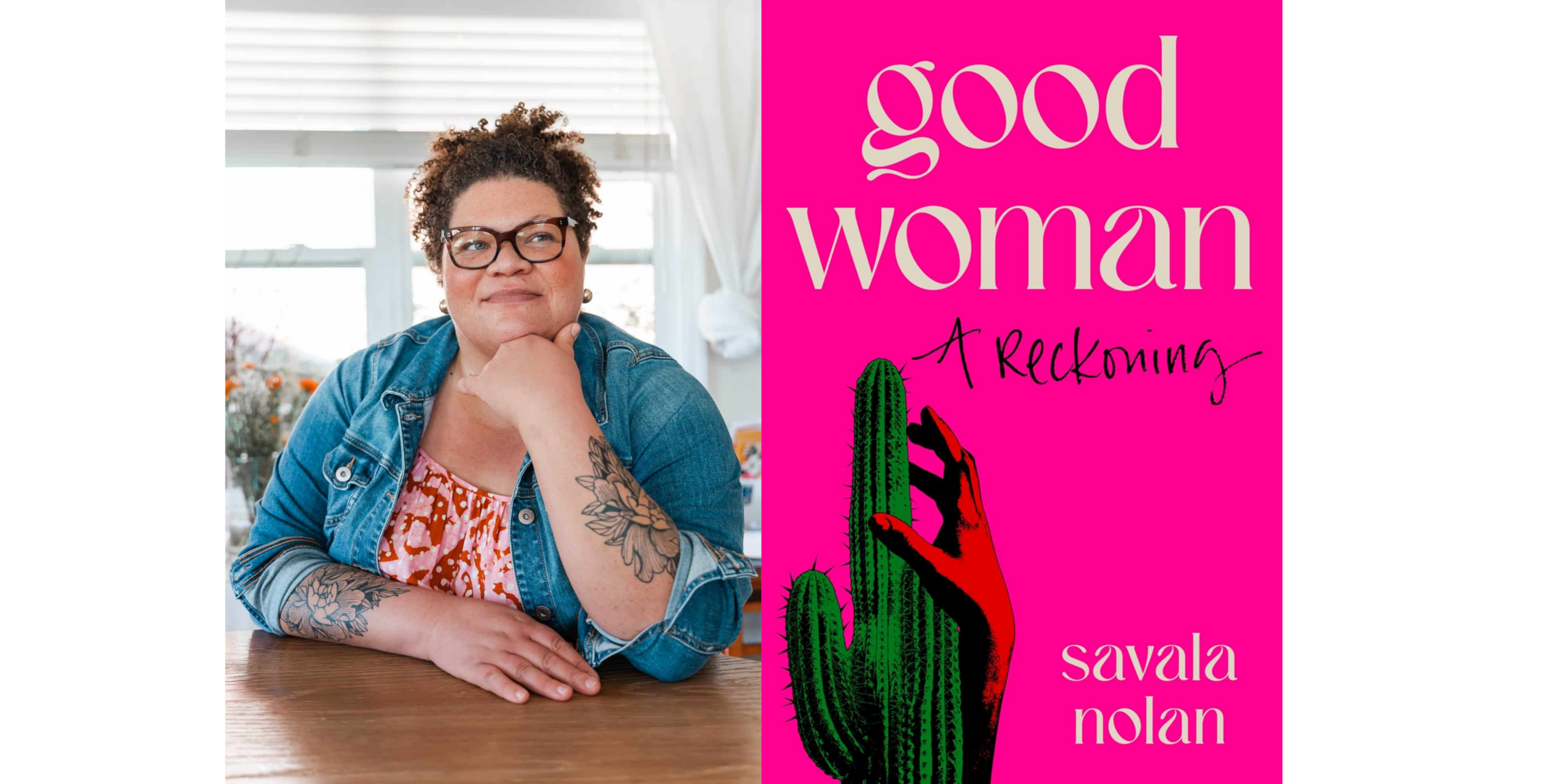
Which Men by Savala Nolan
Originally Published: https://savala.substack.com/p/which-men
Content note: this essay discusses sexual assault.
I’m not a violent person. Still, sometimes I think about the man who sexually assaulted me and fantasize about the pleasure of pummeling his body with, as I’ve heard men say, my bare hands. How far do I go? Do I kill him? No. But I leave him senseless, dented and soft, head lolled to the side, eyes closed. The kind of body you might look at and wonder, is he breathing?
This will never happen. For one thing, the odds of me seeing this guy again are infinitesimal. Last I knew — and this was more than twenty years ago — he lived in Italy, tending bar and sipping little cappuccini, high on charisma but low on potential. He doesn’t strike me as someone I’ll run into in my world. I can’t picture him at, say, a conference on constitutional law hosted by an Ivy League university, or next to me flying First Class. But if I saw him, I’d recognize him instantly, his brown eyes, glittering coldly; like looking into the eyes of a wild animal — there is connection, but not shared consciousness, or there is shared consciousness, but not connection. That’s how his eyes were the night he assaulted me.
A hazy neon light glowing in my peripheral vision, the thick feeling of a velvet curtain, the loud music, whatever was popular then — maybe Mary J. Blige’s Family Affair, which often played there. I can easily relive the feeling of the wall against my back, and his warm, steely body, soft-skinned and tan. I remember what I was wearing: an ice-blue halter top and brown pants, oh! those brown paints in such a tiny size, purchased my first week in Italy at the Miss Sixty store on via Roma, its arched glass doorway reflecting Florentine passersby. The pants had an attached, functionless, low-slung belt that was, if I remember correctly, the height of fashion in that place, in those days. (Note that I can answer with precision that witness-stand question, what were you wearing?) I put my thumbs through the loops of that belt, drawing attention to my exposed hips, and he put his thumbs through the loops too, which was nice, while we kissed. It turned, though. Out of nowhere the whole thing tilted on its side, warped. I started to shake, I said no, and I pushed on his chest. He proceeded anyway. And though I was crying as I ran out of the club, thought I knew what he’d done was wrong, was a transgression, and was obviously sexual, I didn’t call it sexual assault.
I didn’t call it sexual assault, or call myself a survivor/victim of sexual assault, for reasons many women will recognize, and which struck me as obvious. First, I knew him and he was a nice guy — a real sweetheart, always giving us free drinks and compliments, and I really liked him, and we’d hooked up before. So maybe it was a misunderstanding.
Second, I didn’t call it sexual assault because it could have been worse. Almost instantly, I allowed this notion that my assault “wasn’t that bad” to prevent me from addressing my pain and anger. To be sure, there is a spectrum of violence, and what happened to me is not at the most extreme end of it. But I did lose something — innocence, trust, my right to consent to a first kind of sexual encounter. I did endure something — physical and emotional. I was violated. I was never made whole. Part of remaining fragmented and un-whole was this inability to describe or name my experience in unequivocal terms.
Third, I didn’t call it sexual assault because I did not want to be a girl or woman who’d been sexually assaulted. That identity felt at odds with how I wanted to be: empowered, cute, unburdened, clean. Poet Terry Tempest Williams observes that, even though we desperately need them, words are “always a gamble.” They might give us something — clarity, perhaps — but take something, too, like other options and alternative explanations. If I claimed the identity — the language — of victimization and survival, I stood to gain insight, fellowship, righteousness. But I also, perhaps, stood to lose.
I was twenty-one that night with Luca. I was thirty-nine the first time I mentioned it with a therapist. I described it as “something that happened.” I was bringing it up because, suddenly after 18 years, thinking about it made me feel like I couldn’t draw a deep breath. I don’t know why. Perhaps because I had a daughter, and the tenuousness of her safety is rarely far from my mind, or perhaps because the experience simply couldn’t stay repressed any longer, and it had to bust out of where I’d stashed it, a box in my pelvis labeled disappear. Talking about it felt like an admission even though I’d done nothing wrong. I shared the story — the club, the dark room, the neon light, the belt loops, the pushing — and got to the end, to the part where it was over, and I asked my therapist, “But was it even sexual assault if he didn’t use his penis? If he only used his hand?” Yes, she said, it was. Her tone was adamant.
Later that day, I called my best friend of twenty-five years. She was home in Los Angeles, and I thought of the hot Santa Ana wind washing over her just as the cool Pacific wind washed over me. I asked her if she’d ever been sexually assaulted. I was nervous to ask, as if I were asking her to reveal something hideous, something wrong about her body, something wrong about mine — do you have secret hairy squid tentacles growing out of your inner thighs, too? It was a conversation we’d never had before. She said “I don’t know.” She said she’d have to think about it. It strikes me now, as an older woman with a deeper political consciousness, that this is a remarkable answer, that you could write a doctoral thesis about this answer. Imagine another question about bodily trespass — have you ever been shot? have you ever been stabbed? have you ever been hit by a car? — where the victim/survivor would need time to contemplate whether it had happened. But, I get it; the same social forces that made her unclear on whether she’d ever been sexually assaulted had made me unclear, too. Maybe? No, I don’t think so, but possibly. Kind of, I’m not sure. Before we hung up, she said she did recall one time, decades ago, being groped by a cab driver, but wasn’t sure whether that “counted.”
Legally, it does. So does what happened to me. There is no question about this. The Rape, Abuse & Incest National Network (RAINN), the United States’s largest anti-sexual violence organization and an organization whose definitions center survivors and victims in a way that laws may not, defines sexual assault as “sexual contact or behavior that occurs without explicit consent of the victim.” California law, under which I currently live, defines sexual battery as, in part, “touching an intimate part of another person where the touching is against the will of the victim and is for the specific purpose of sexual arousal [or] sexual gratification.” And Italy, where I was assaulted, defines sexual violence as using force, threats, or the abuse of authority to force another person to commit or suffer sexual acts. Mine is a clear-cut case in any relevant jurisdiction. With my therapist’s help, I was able to see this.
I was also able to see the other reason I’d avoided the truth: I didn’t want to think about whether the men I’m close to had ever done what Luca did. Rejecting the proximity of sexual assault to my own life allowed me also to reject the potential proximity of people who sexually assault, ninety percent of whom are men.1
Among that ninety percent may be men I love. Men I have worked with. Men who have driven me home. Men who have come into my house to repair heaters and washing machines. Men I have dated or slept with (or married). Men who are my friends. Men who raised me, taught me. “Good” men. The problem is that maybe, by believing the men in my life are good without verifying their goodness, I fool myself. Maybe I assume innocence when that should not be the presumption. After all, undoubtedly, at least some of Luca’s friends and family believed — perhaps still believe — he could never be the perpetrator of sexual violence. This is the burden women and girls must carry, but about which we aren’t supposed to complain: not all men, ok, but to give the benefit of the doubt to all men, to give them all the grace of our trust, can get you killed, abused, or attacked. This isn’t hypothetical. It happened to me.
It has also happened to millions, and millions, and millions of women in this country alone. Sexual assault is underreported.2 Still, we can estimate that nearly twenty-five percent of women in college have been sexually assaulted — that is close to two million female students, more than the entire population of a city like Philadelphia, or San Francisco, or Dallas. One out of every six American women has been the victim of an attempted or completed rape; that is almost twenty seven million people, or the entire populations of Switzerland, Israel, and Sweden combined. More than half of American women have been sexually assaulted — about the same number as the entire populations of Canada and Spain together. I will say it again: men are doing this to many women. And we don’t know which men; instead, we know only that almost seventy five percent of sexual assaults are committed by someone the victim knows. My lived experience bears this out. My social circle includes at least three women who were molested by a brother; one who was molested by her father; one who was molested by an uncle; one who was raped by a fellow church member; four who were sexually assaulted by boyfriends and/or husbands, and so on. These are intimate crimes in every sense. They involve intimate parts of the body, intimate violation, and intimate — or at least established — relationships. If anyone is going to assault me again, it will likely be a man I know. But is it likely that a man I know has committed assault?
A study from the University of Kent illustrates the dizzying state of un-knowledge that results from living under the weight of not all men, but which men. Of 554 male students who participated in a survey about sexual conduct, 63 reported that they had committed assault, rape, or other coercive and unwanted conduct in the past two years. How many assaults, rapes, etc., are we talking about? 251. I am reassured, for lack of a less enthusiastic word, that it seems we’re looking at “just a few” men committing serial crimes, and not many men committing one-offs. But I am aghast that a full eleven percent of men surveyed admitted to sexually violent conduct — and again, which men.
I suppose I could just ask and then know once and for all. My ex-husband, my brother and cousins, my professional relations, my old roommates, the man I’m currently dating…hey, so, have you ever sexually assaulted someone? Putting aside the incongruity of asking women, who are powerfully conditioned not to bother or upset men, to toss all that conditioning to the side in order to inquire about a man’s possible history sexual violence, there is at least one colossal problem with that fantasy: men’s answers might not be trustworthy. This is a different problem than they might lie. This problem is better understood as their assessment might be honest but completely inaccurate. Because it seems a decent number of men aren’t very good at identifying sexual assault that isn’t explicitly called “rape.” Multiple studies have shown that when you ask male participants have you ever raped someone and also have you ever coerced someone into having sex with you, the same men will answer no to the former and yes to the latter. Most recently, a study at the University of North Dakota found that while “only” 13.6 percent of men said they would rape a woman if there were no consequences, a whopping 31.7 percent said they would “force a woman to have sexual intercourse.” The word rape, it seems, is more off-putting to these men than the act that defines it.
To be sure, language presents a conundrum: rape/force and coerce are not necessarily synonyms. If someone nags you or badgers you or bugs you or begs you or pesters you or hounds you and you cave in, allowing sex you don’t really want to happen, have they coerced you? Have they forced you? Have they raped you? Or have they participated, alongside you, in the sexual economy of, say, a typical long-term relationship, during which sex drives are sometimes mismatched and sex is sometimes an act of kindness, or maintenance, or procreative windows. What feels like coercion to one person may feel like seduction to another; this reality alone suggests that the words we have to discuss these issues are as limited, shaky, inconsistent, and fallible as our collective thinking. Moreover, why do we resist holding men accountable for anything but the worst expressions of sexual domination? Why do we accept that insisting, pestering, badgering, and arm-twisting could just be par for the course?
Part of the problem, I think, is that words like force, coerce, and rape, along with their squishier cousins cajole, press, nag, and so on, force us to think about what the transgressor did rather than what the transgressed-upon experienced. In the context of sexual assault, which is so gendered, this means we have once more become engrossed by men and boys — what they did or didn’t do — instead of zeroing in on women in girls. And because we live in a world where men are deemed superior, we are more likely to protect their prerogatives than protect women. This learned reflex of centering male experience and male action while marginalizing female experience is exactly what consent culture strives to correct when it stresses that, ultimately, the identification of a coercive sexual act lies not in the nature or degree of coercion but in the consent or lack thereof. Under this rubric, it does matter that there is a distinction between, for example, pestering someone for sex and all-out forcing them, and we should recognize that coercion exists on a spectrum, but the only person who can say whether an incident was consensual is the person to whom it happened.
The day when consent culture reigns may not be far off. Then again, who knows? Asking women to confidently refuse or withdraw consent feels almost cruel in a culture that constantly socializes women to prioritize other people’s feelings and subsume their own. At the turn of the millennium, an Emory University study asked 1000 sexually-active teenage girls what they most wanted to know about pregnancy prevention, and 85% said “how to say no without hurting the other person’s feelings.”
As much as I have always scoffed at people who complain that seeking clear, affirmative consent ruins the moment, when faced with having a consent-focused sex life, I found myself slightly adrift. I recently dated a man who, before putting his hands on my breasts for the first time, said, “Can I touch them?” It threw me. I looked around, unintentionally comic, like what’s going on? “Yeah,” I said. He did it again when his hand was over my leg. Can I touch your thigh? I paused, perplexed. Yeah… After he’d gone home, I stood at the sink washing our wine glasses, recounting this mysterious interaction to my best friend. Why the hell did he keep asking? What was that about? She was puzzled, too, then proclaimed, Oh my god, he was seeking consent! It struck me as generational. At the time of this date, I was 42 and he was 31. I was used to being, well, manhandled (the word says it all). I was raised to expect a slightly scary, take-charge energy from the men I’m sleeping with. I was raised to recognize and trust my own desirability only if a man seemed nearly unable to control himself. Hooking up with a guy who received, however cursory, a more conscientious, consent-rooted orientation to sexuality meant adjusting my own frequency, tuning the knobs of my sexuality until I didn’t expect or require a frenzied, ravishing, bodice-ripper vibe in order to feel sexy. It took a while, if I’m honest, and in the back of my mind I wondered whether my 31-year-old date was even into me. Indeed, straight men who focus on consent, or who aren’t that into sex, or who just have a slow pace risk their sexuality and sexual appetites coming into question. They can seem “gay,” or otherwise “off” by the standards of heteronormativity, and their straight, female partners might wonder what the hell is going on. This is part of the bizarre lie that straight culture, and rape culture, sell to men and women alike: that male attraction must always contain a dose of brutishness, or at least a bit of force, to be real.
Another dilemma straight men face: how to like women when we live in a culture that doesn’t. It must be disorienting to desire closeness and communion with members of a subordinated class. Scholar Jane Ward describes this as “the misogyny paradox,” i.e., “the cultural expectation that men should like women [as sexual and romantic partners] even as they are socialized into a culture that normalizes men’s hatred of women.” She writes that we, as a culture, have not yet completed the “transition from woman-as-degraded-subordinate to woman-as-worthy-of-deep-love.” Accordingly, men who cherish their women and bend themselves to their women’s needs, desires, and wellbeing might be teased for being pussy-whipped, cunt-struck, or henpecked instead of being celebrated as role models. Men who do “female” things like wear nail polish or skirts, or are interested in “female” things like expressing emotions are teased for incorrectly performing their gender. Little boys who have crushes on little girls get away with pulling their hair, as if these are appropriate gestures of desire. Men who catcall women admiringly will, if that woman doesn’t respond with open, grateful reciprocity, flip on a dime, calling her a dumb bitch. A father can simultaneously love his teenage daughter and get off on violent porn narratives about punishing “slutty” underage girls. And, years ago, a man I was friendly with could in the span of ten minutes delight in my company and sexually attack me.
The sloppiness of our language and of our thinking, means women are subtly encouraged to spend years ignoring their wounds, or trying to define them precisely instead of tending to them. This is madness. Imagine a doctor refusing to suture a gash until the patient could explain exactly what type of blade created it, refusing to clean a bullet wound because they did not know the bullet’s caliber. In the thick of monoculture moments and phenomena — the #metoo movement, the film Promising Young Woman, the Aziz Ansari wahala — many women published articles with headlines like “It took me 12 years to realize I’d been raped”. Mental health experts call this trauma response “unacknowledged rape” or “unacknowledged assault” — meaning unacknowledged by the survivors, who, sometimes for years, referred to their sexual assault with words (always a gamble!) like “bad sex,” “miscommunication,” or “a weird night.” A recent study from the University of Mary Washington estimates that 60% of female students experience unacknowledged rape. Women are often unfairly treated like unreliable narrators when we seek justice from the men and systems that harm us (or even just name them). When we speak truth to power, particularly about sexual violence, we are often disbelieved, made fun of, and accused of wanting things like fame and money. But personal experience and the data tells me that, when we fail to “reliably” narrate our stories, it isn’t because we’re making shit up to screw a man over. It’s because a lifetime of living in sexism blocks us from seeing when we’ve been trespassed against, and our language fails survivors. The benefit of that “unreliable narration” redounds to systemic misogyny, not to us.
I haven’t a clue whether Luca thinks of himself as someone who sexually assaulted a girl he once knew; but it’s more likely, I think, that he considers that night a time he tried to get laid but didn’t. This is if he considers that night at all. I haven’t a clue whether my male friends, family, and colleagues have their own versions of those nights, in which they were some version, slightly better or perhaps much worse, of Luca. And I don’t know whether they have the capacity — the language, education, emotional depth, self-awareness, and awareness of their partners — to ever see their actions as battery and assault, even if a neutral, educated outside observer would.
Some theorists believe it is impossible for straight women to have nonviolent sex with straight men. The atmosphere of misogyny is just too pervasive, the miasma of animosity and revulsion too thick. I don’t love the idea that every time I’ve fucked a man it has been an experience of, on some level, at least partial violence, be it philosophical or physical. But I find the logic hard to write off entirely, particularly when I consider the words we use to describe how men have straight, penis-in-vagina sex with women: “murder that pussy,” “beat the pussy up,” “choke her out,” “smash it,” “dig her out,” “tear it up,” “rearrange her guts,” “nail her,” “pound her,” “bang her,” “make it burn,” “blow her back out,” “screw her,” “slaughter,” “kill it,” “hit,” etc. If that is what a man is doing to me (and these are things done to women, not with them) am I to understand the encounter as…peaceful? From writer Constance Grady: “Our words for sex are violent — pound, hit, bang — and our expressions for violent anger are sexual: fuck off, go fuck yourself, suck my dick. Our language treats violence and sex as near equivalents.”3 It’s a depressing thought — that just because men love their female partners doesn’t mean they can scrub themselves of the male supremacy and female subordination in which they’ve been born, educated, and come of age. But I have no trouble accepting that we don’t know what America looks like without anti-Black racism, for instance, simply because we’ve never seen it. Nothing controversial in that observation, I don’t think; yet we recoil from concluding that straight sex is caught in the same kind of cultural path-dependence. If there is a logical reason for this, I don’t see it.
Consider, also, what goes on in free, mainstream porn — which I am not categorically opposed to, but which constitutes a meaningful amount of dense, high-octane, highly-suspect “food” for the male sexual/romantic psyche, with nearly all men watching porn, and the average straight man watching it for more than an hour each week. Again, I don’t take issue with that on its face. Getting off, including through watching other people have sex, is fine, at least as a general proposition. But to call porn people having sex elides the vicious — even sadistic — truth of what these men are watching: researchers from the University of Arkansas studied 304 scenes from popular pornography videos and found that nearly 90 percent of them included violence against women (choking, slapping, gagging, hair pulling, etc), to which the women generally responded neutrally or positively. A second and larger study from Indiana University examined 4,009 videos of straight sex from mainstream porn sites found “women were the target of the aggression in 97% of the scenes, and their response either neutral or positive and rarely negative.” According to the Archives of Sexual Behavior, mainstream porn tropes have become “a primary source of sexual education,” embedding new codes of sexual behavior in young men. A recent ASB survey of 487 American college-age men indicates that “the more pornography a man watches, the more likely he was to request particular pornographic sex acts of his partner,” including non-consensual, painful anal sex and non-consensual choking, both of which are on the increase among teens and college-age adults. (Note, also, that when choking constricts breathing it makes it impossible to say stop.)
Look. Human sexuality is complicated. The diversity of human preferences and the vagaries of sexual imagination are not the problem. My point here is simply that we struggle mightily, at least in mainstream straight culture, to separate sex and violence. This struggle plays out in language and in depictions of sex designed for sexual gratification. Is it any wonder that women sometimes struggle for decades to understand that the “sex” they had was actually assault, or that men sometimes struggle to understand that assaults they committed weren’t just “sex”?
Porn, of course, isn’t the only reason many men and boys have a skewed sense of sexuality, one that concentrates on male desire while lobbing female desire to the shadows. From commerce and consumerism to our understanding of puberty, male desire is our North Star, while female desire has been dumped into a ditch. Turns out the Internet is lousy with baby onesies featuring the words daddy just wanted a blow job. But a onesie that says mommy just wanted to ride daddy’s face? That garment doesn’t exist. Or consider that desire is deemed the primary sign/characteristic of sexual maturity in men, while the possibility of pregnancy is treated like the primary sign of sexual maturity in women. The sexual appetites of teenage girls, for example, get far less airtime in this culture than the sexual appetites of teenage boys, even though studies show sexual desire is equal among the sexes. What isn’t equal is the sense of entitlement to express and fulfill those desires, and the entitlement to layer one’s sexual desire onto pre-existing power dynamics and gender hierarchies.
*
It can feel unbearable that the men I know are, in such an important way, basically unknowable. Because I was told not to ask. And because the men might not be able to accurately describe their own appetites, or experiences, or actions. Because there is a wide, deep zone of sexual violence and assault which we, collectively, prefer to call by another name. Trying to get laid. Being a little persistent. Going for it. I’m just beginning to tabulate the cost of this gendered ignorance, this subordination — of not being able to ascertain how dangerous the world is because it is too scary, maybe even pointless, to ask. I’m not actively afraid of any particular man I know, but I’m afraid of what I may not know, and what they may not know about themselves. The uncertainty is punishing. I, not they, pay the price — when I can’t relax enough to orgasm, when I must gamble with my safety, when I am exhorted to dole out my trust even though it hasn’t been earned. This is another defeat and devastation connected to that night, twenty years ago, when an awesome guy I knew sexually assaulted me. I carry it all with me, and don’t know if there is anywhere or any way to lay it down.
If you or someone you know has been sexually assaulted, or needs help understanding whether an experience constitutes sexual assault, help is available. You can contact RAINN’s confidential hotline 24 hours a day at 800–656–4673 or at online.rainn.org. More resources are listed at https://www.rainn.org/resources.
Originally published at https://savala.substack.com on October 7, 2026.
www.authorsunbound.com/savala-nolan/