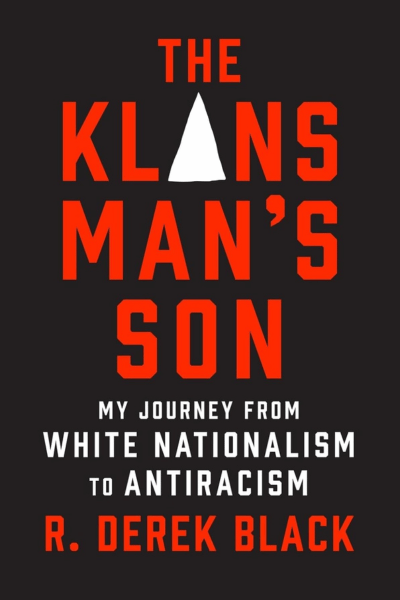

“If ever there was a book for these challenging times, it’s The Klansman’s Son by R. Derek Black… ” — Charlayne Hunter-Gault, journalist and author My People: Five Decades of Writing about Black Lives

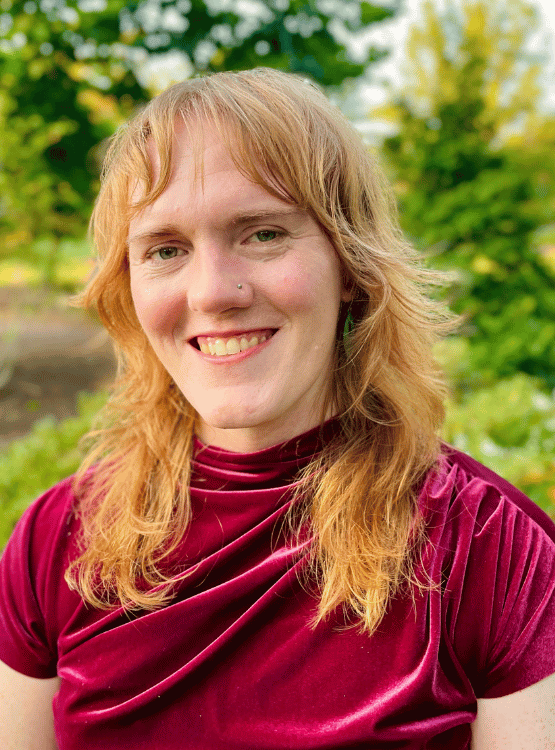
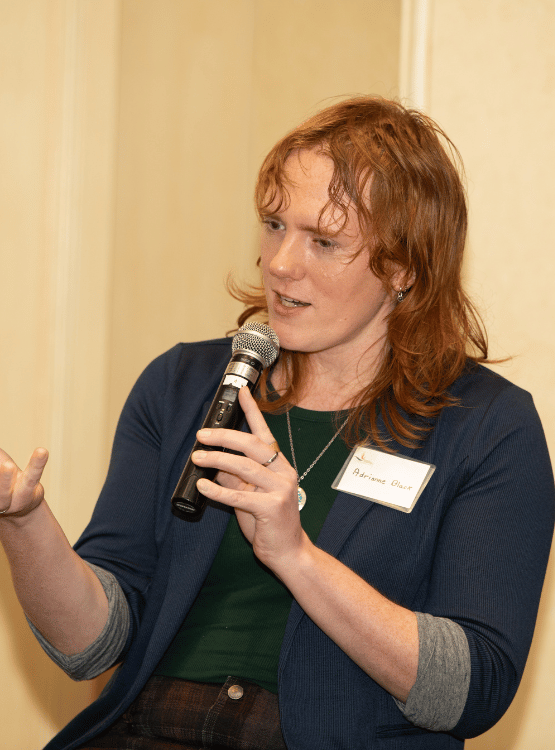
Adrianne F. Black is a historian, writer, and narrative collaborator whose work centers community, belief, and the language through which people understand one another. She studies how ideas take hold, why people cling to them, what relationships make change possible, and how communities communicate values with clarity and care. Her writing and speaking draw from her own experience growing up in one of the leading families of the American white nationalist movement and being groomed to inherit its leadership, and from the long, disorienting process of changing her mind. She argues that deeply held beliefs rarely shift through facts alone, but through expanding circles of trust built across friendships, institutions, and sustained conversation.

Formerly published as R. Derek Black, she also writes and speaks about the moral panics and harms directed at trans kids and adults, and the role that belonging, safety, and care play in how we imagine one another. Across issues, her work asks how people make meaning together, and what responsibility we have to tell the truth about harm while staying in community.

Black collaborates with institutions and cities to translate values into public language and shared understanding. She has worked with the U.S. Holocaust Memorial Museum, Facing History and Ourselves, the Center for American Progress, and the Antiracist Research and Policy Center to develop narrative frameworks, staff education, lesson plans, and public-facing resources that counter racist and antisemitic beliefs. In Baltimore, she works with residents, artists, and planners on messaging for Vision Zero and on walkability and transit access as expressions of civic connection and everyday dignity.

She is the author of The Klansman’s Son: My Journey From White Nationalism to Antiracism (Abrams, 2024). Her essays and commentary have appeared in The New York Times, USA Today, TIME, and Newsweek, and her public storytelling has reached broad audiences through NPR’s Fresh Air, The Daily, On Being, Brief But Spectacular, and The Daily Show, with additional coverage in The Washington Post, People, and O, The Oprah Magazine. Since 2016, she has spoken nationally at major universities and institutions, including the Harvard Institute of Politics, the Yale Politics Initiative, MIT, Stanford, American University, and the University of Virginia, as well as the Chicago Humanities Festival and Goldman Sachs.

Black is the recipient of the inaugural Elie Wiesel Award, presented by the Wiesel family, and a humanitarian award from the Anti-Defamation League. In 2024, her work was honored by the Holocaust & Human Rights Education Center, and formally recognized by New York State Senate and Assembly commendations and a Westchester County proclamation.

Adrianne lives in Baltimore, where she is currently developing new writing on civic belonging, persuasion, and the shared language of public life, and works with organizations seeking to communicate with nuance, accountability, and care.
Adrianne's Featured Titles

The Klansman’s Son: My Journey from White Nationalism to Antiracism: A Memoir

Harry N. Abrams |
Memoir

From the former heir-apparent to white nationalism, The Klansman’s Son is an astonishing memoir of a childhood built on fear, of breaking from a community of hate.

When coded language and creeping authoritarianism spread the ideas of white nationalists, this is an essential book with a powerful voice.

Derek Black was raised to take over the white nationalist movement in the United States. Their father, Don Black, was a former Grand Wizard in the Ku Klux Klan and started Stormfront, the internet’s first white supremacist website—Derek built the kids’ page. David Duke, was also their close family friend and mentor. Racist hatred, though often wrapped up in respectability, was all Derek knew.

Then, while in college in 2013, Derek publicly renounced white nationalism and apologized for their actions and the suffering that they had caused. The majority of their family stopped speaking to them, and they disappeared into academia, convinced that they had done so much harm that there was no place for them in public life.

But in 2016, as they watched the rise of Donald Trump, they immediately recognized what they were hearing—the spread and mainstreaming of the hate they had helped cultivate—and they knew that they couldn’t stay silent.

This is a thoughtful, insightful, and moving account of a singular life, with important lessons for our troubled times. Derek can trace a uniquely insider account of the rise of white nationalism, and how a child indoctrinated with hate can become an anti-racist adult. Few understand the ideology, motivations, or tactics of the white nationalist movement like Derek, and few have ever made so profound a change.

Authors-Unbound_icon-web-link.png

Belonging, Identity, and the Hard Work of Leaving an Ideology

What we call “changing our minds,” I argue, shouldn’t be understood primarily as a process of being persuaded to accept different ideas. The process of changing any fundamental beliefs is first an act of expanding the people we feel responsible for and then being open to hearing how we affect them. I don’t speak about extremism and my upbringing and experience of leaving and condemning the international white nationalist movement because I want simply to dredge up how bad it gets, but because of what it reveals about how our society deals with inequality everywhere. Leaving my ideology was not only a matter of discovering I was wrong. It was a process that confronted me with the realization that anything less than changing how I identified myself in the world meant rejecting people I claimed to care about. That experience confronted me the realization that I would otherwise be a person I didn’t respect. It made me realize how devastating the act of losing my family and community felt, and how it tied me to ethics I could no longer defend. Most people will not face that reckoning in such a dramatic way, but the question we all have to ask is the same: how do you live your values when your community or identity inevitably asks you to cut your circle of obligation short of someone who needs you and whom you feel connected to? People often make themselves feel safe by isolating inside communities that narrow the answer to whom we owe something, to limit the opportunities to question that, and they rationalize that limiting as maturity, simplicity, or self protection. Belonging somewhere feels like relief until it creates boundaries between us and another person’s pain. Being known and being held accountable will always create tension. Yet the moment we accept hearing what our beliefs do to someone we care about, we must also then make decisions whether and how to align ourselves with the person we believe we are. This talk is not only about personal transformation as an individual, unique experience that it always is, but also as a practice of what it takes to keep our actions and values aligned, so we proudly recognize the person reflected back at us.

Authors-Unbound_icon-web-link.png

Preventing Right-Wing Populism: What Belonging Has to Do With Extremism

Movements like the one I grew up in didn’t begin with ideology, but with a desire by its members for belonging. The attraction of such movements is that they narrow who we are demanded to care about in ways that feel protective, stabilizing, even righteous in how simple the answers can sound. I am less interested in tracking the right than in what its existence reveals about us: that most people, across communities and politics, are tempted to shrink who they feel responsible for when life becomes frightening or uncertain. Prevention means asking what we can build that expands the emotional and civic ground where belonging is possible, so people don’t reach for movements that set ideological boundaries of who is human or who matters. I draw here from my experience as well as from work in Germany, where remembrance, youth work, and civic ritual are used not only to confront the past but to train responsibility into the present. The question is not how to recognize extremism but how to recognize the subtler ways we narrow our obligations long before we adopt an ideology, and what communities can create. Most people don’t ever recognize themselves choosing contempt or hate. They see themselves seeking belonging, and then live with what they believe that requires of them.

Authors-Unbound_icon-web-link.png

Workshop: Translating Values into Public Language: How Institutions Widen (or Narrow) Their Circle of Obligation

Institutions often claim values they struggle to live aloud: they want to oppose antisemitism without flattening history into slogans; they want to affirm trans students or staff without retreating into euphemism; they want to confront racism without reducing harm to a single narrative of innocence and guilt; they want to speak about safety. In this workshop, we work with the actual language participants use: drafts, mission statements, press releases, statements after crisis, policies written in caution or fear, and explore how those words either widen or narrow the circle of who the institution feels responsible for. I am less interested in perfect phrasing than in keeping personal and institutional responsibility at the forefront and keeping human language and values firm against watering down. It is possible to stop writing as if we must convince everyone, and instead make choices and take positions to be accountable and responsible for the people who are most harmed by silence. Together, we revise and rewrite not to polish but to understand: what are we protecting, who disappears when we hedge, and what becomes possible when we say plainly what we owe each other. The goal is not messaging that pleases everyone, but language that reflects who the institution is trying to become. Sometimes the hardest thing to say is the simplest.

Authors-Unbound_icon-web-link.png

Workshop: Case Studies in Activism, Community Organizing, and Public Life

Developed as two seminars given originally for the Yale Politics Initiative, in this workshop I introduce my own life story and experiences at the start, telling the lessons I’ve taken from my journey and what I believe is transferable to many different situations. This is a 2-3 hour workshop intended for students who hope to pursue advocacy or activism at any level in their own communities, whether that be through individual relationships, institutional change, political campaigns, or issue advocacy. The seminar focuses on one of a series of case studies from my own life working in movement activism—both as a young person growing up at the center of the international white power movement, organizing rallies, trainings, and conferences for that movement, as well as my experiences over a decade around the world working with organizations and individuals advocating for antiracism and social justice. In the workshop, I present a real-world scenario, describing the different competing ideological and identity factions and events that led up to the event, and ask students to break out into groups assigned to think through the decisions and goals of each real world set of goals and people. They discuss and predict what they think their group did and how the event occurred. We close the seminar by hearing what they believed the motivations of their historical actors led them to do. Then I present what really happened and how their expectations were confirmed or changed.

Authors-Unbound_icon-web-link.png

Belonging as Civic Infrastructure: What Baltimore Shows About How People Care for Each Other

A life lived walking creates places where people can encounter one another without effort or planning, build communities, and see one another in ways that highways and windshields blind people. I don’t speak about walkability as an aesthetic or a trend, but as something I’ve come to understand while living in Baltimore, where people can still see and reach one another physically because of a built environment that is human scale and not built for cars. That proximity has helped communities care for themselves despite decades of disinvestment, segregation, and wealth that left and did not return. Baltimore’s built environment was shaped before cars, and the physical inheritance of that time—rowhouses, mixed-income blocks, corner stores, small parks, narrow streets—has made it possible for people to live near each other in ways that most other American cities were destroyed by highway construction and urban demolition. Many larger, richer cities have spent fortunes trying to recreate that environment that Balltimoreans fought to keep and which was largely left alone because of the rapid disinvestment of a once wealthy city. Preserving and rebuilding that older wisdom about to create human environments where people do not get in cars regularly is the single most effective policy intervention a government can make to combat loneliness and isolation. Sometimes what looks like decay is actually the persistence of a design that still knows how people can live with one another.

My main talk thesis statement: “People change not when they admit they’re wrong, but when they expand who they feel responsible for.”

That’s the work that travels across:

Trans Panic
Antiracism Conflicts
Civic Fragmentation
Race-Blind vs. Race-Conscious Arguments
Transportation as Dignity
Memorialization
Narrative Responsibility
Harm and Denial
Polarization
Belonging/Dislocation
Moral Injury
Persuasion
Friendship
Founders’ Networks
Academia & Institutions
Love

It’s all the same question;

Who do you think you owe something to, and why? What would it take to expand that sense, and what would it change about your beliefs or actions?

Honors, Awards & Recognition

Jewish Book Council Book Club Pick, November 2024
Honoree, Holocaust and Human Rights Education Center, 2024
ADL Kay Family Humanitarian Award, 2019
Elie Wiesel Award, Presented by Wiesel Family, 2017

Media Kit

By clicking the link below you will be directed to a Google Docs Folder
where you can download author photos and cover images.

Similar Authors

Abby
Memoirist & Educator
Jessica
Critically Acclaimed Nonfiction Writer
Justin

Lee

Bridge-Builder
Savala
Acclaimed Essayist
Reyna
Bestselling Memoirist & Novelist

We’ve received your Message!

An AU Representative will connect with you as soon as possible.